India’s Prototype Wind Turbine Rules: From Testing Cost to Saleable Power
Wind-turbine innovation requires real operating data. New models must be installed, connected to the grid and tested under actual wind, temperature and electrical conditions before they can enter commercial deployment.
That process is technically necessary but financially demanding. A prototype may generate electricity for months while manufacturers carry the cost of equipment, land, testing, certification, operations and grid connection.
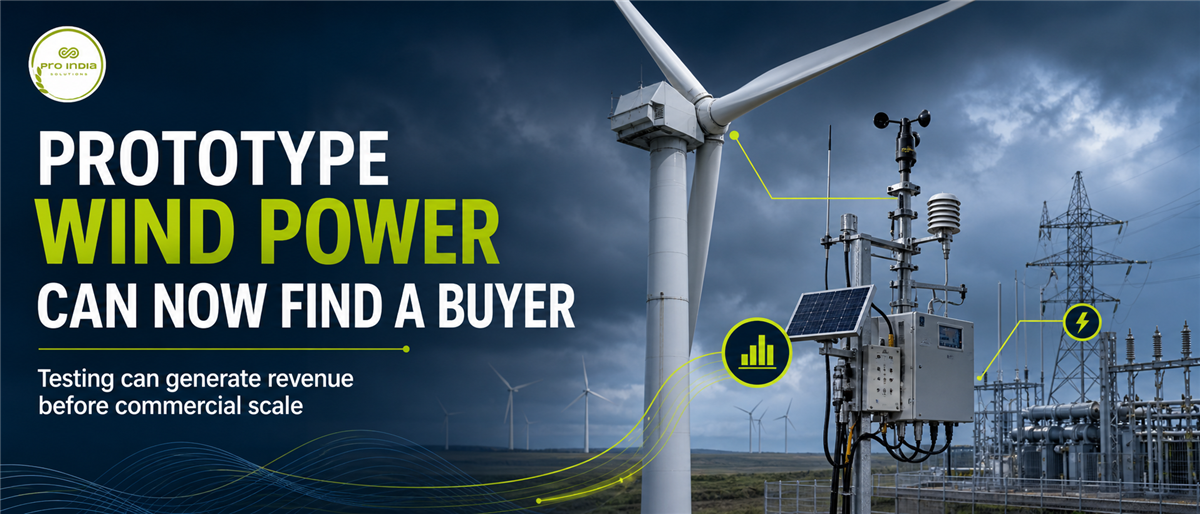
MNRE’s amendment dated 25 June 2026 changes part of that equation. Scheduled power generated by prototype wind turbines may now be procured by distribution companies or other entities. Procurement may use a mutually agreed tariff or a tariff determined under CERC or the relevant SERC regulations.
The amendment keeps the maximum of three turbines per prototype model. It also preserves the distinction between testing and commercial deployment: mass production and installation depend on the model’s inclusion in ALMM-Wind.
What the amendment changes
The earlier prototype framework enabled limited installation for grid synchronisation, type testing and certification. The new provision gives generated electricity a clearer commercial route.
This does not turn a prototype into an ordinary power project. Testing requirements, certification controls, NIWE processes and technical responsibilities continue to apply.
The change instead creates a way to recognise the economic value of electricity produced during legitimate testing.
Why prototype testing matters
Wind turbines combine large structures, power electronics, controls, blades, gearboxes or direct-drive systems, foundations and grid interfaces. A new model must demonstrate safety, performance and reliability.
Testing can cover power curves, loads, acoustic performance, electrical characteristics and behaviour under different operating conditions. Certification bodies need credible data before a model can progress.
India’s wind conditions also vary by region. Turbines designed for lower wind speeds, higher temperatures or specific grid conditions need field evidence relevant to the intended market.
The commercial benefit
Revenue during testing
Sale of scheduled electricity can offset a portion of prototype operating costs. It will not necessarily fund the entire programme, but it can reduce energy that would otherwise have no defined buyer.
The value depends on tariff, wind resource, availability, scheduling rules, grid losses and the duration of testing.
Stronger utility participation
DISCOM procurement can create a more structured relationship between technology developers and the power system. Utilities gain experience with emerging turbine models while manufacturers demonstrate grid behaviour.
Contracts must still allocate performance, forecasting and curtailment risks appropriately.
Better investment visibility
Investors can assess a prototype programme with both technical milestones and a limited revenue stream. The key remains whether testing leads to certification and market eligibility.
Revenue should not distract from the primary objective of reliable validation.
The limit of three turbines
MNRE retains a maximum of three turbines for each prototype model. The limit protects the distinction between testing and commercial installation.
Manufacturers should not treat the prototype route as an alternative to product approval. Sites should be sized around the testing plan, certification requirements and expected data quality.
Multiple turbines may help test variants or gather operational evidence, but every installation should have a documented purpose.
ALMM-Wind remains the commercial gate
The amendment links commercial mass production and installation to inclusion in the Approved List of Models and Manufacturers for wind turbines.
ALMM-Wind provides a market-entry control based on required documentation, certification and manufacturing conditions. A prototype may synchronise and sell power under the guideline, but wider deployment cannot proceed merely because the turbine is operating.
Developers and buyers should verify list status before entering commercial supply arrangements.
Contracting questions
Prototype power procurement needs contracts suited to a test asset.
The parties should address:
- scheduling and forecasting responsibility;
- metering and settlement;
- tariff and regulatory change;
- testing outages and planned downtime;
- curtailment;
- grid-code compliance;
- liability and insurance;
- ownership of environmental attributes; and
- termination if certification is delayed or unsuccessful.
A standard commercial PPA may not reflect the uncertainty of prototype operations.
What manufacturers should do
Manufacturers should integrate engineering, certification, regulatory and commercial planning from the start.
The test plan should define the required measurements, timetable and certifying body. The grid and offtake design should support that plan rather than constrain it.
Project records should capture NIWE recommendations, turbine configuration, component changes, test results, maintenance, generation and compliance correspondence.
Any modification to the prototype must be controlled so that certification evidence remains valid.
What buyers and DISCOMs should examine
Buyers should understand that prototype generation may have different availability from a mature commercial plant. Forecasting and outage assumptions should be realistic.
Due diligence should cover project approvals, testing status, metering, grid connectivity and the identity of the responsible manufacturer.
The buyer should also clarify renewable-energy attributes and whether they can be claimed under applicable accounting and regulatory rules.
Implications for India’s wind supply chain
India’s wind market needs turbine models suited to domestic conditions and competitive project economics. A clearer prototype pathway can encourage product development, component localisation and field validation.
Testing activity also supports specialised services: instrumentation, certification, data analysis, maintenance, grid studies and insurance.
The amendment may be especially relevant for larger turbines, new control systems and models designed for lower-wind sites.
Risk management
Prototype programmes carry technology, schedule and certification risk. Power-sale revenue should be modelled conservatively.
Companies should avoid assuming commercial deployment before approval. Supply contracts, manufacturing investments and developer commitments should recognise the ALMM-Wind gate.
Environmental and land approvals, aviation and defence clearances, grid connectivity and local stakeholder requirements may also affect the site.
A practical readiness checklist
Before installing a prototype, review:
- NIWE and certification requirements;
- the maximum number of turbines;
- site and grid approvals;
- testing scope and instrumentation;
- offtake eligibility and tariff route;
- scheduling and settlement arrangements;
- maintenance and safety responsibilities;
- insurance and liability;
- the ALMM-Wind inclusion pathway; and
- evidence needed for commercial scale-up.
The commercial agreement and certification programme should use the same turbine configuration and timetable.
Future outlook
The amendment can make India a more attractive environment for testing wind technology. Revenue from scheduled power improves the economics without removing the need for certification.
Its success will depend on practical procurement arrangements, predictable grid processes and disciplined separation between prototypes and approved commercial models.
If implemented well, the framework can shorten the distance between engineering innovation and bankable deployment.
Conclusion
MNRE’s revised rule gives prototype wind generation a commercial outlet while retaining limits and approval controls. Manufacturers can recover part of testing cost, buyers can access renewable electricity, and the market can gain evidence on new technology.
The opportunity requires careful contracting, reliable testing and a clear ALMM-Wind pathway.
PRO India helps clean-energy businesses connect policy requirements with project execution, commercial controls and credible sustainability evidence. Visit https://proindia.net/ to discuss renewable-energy readiness.