COP28, COP29 & COP30: A Three-Year Journey from Ambition to Action
Over the past three years, the global climate conversation has undergone a significant transformation. While climate conferences have often been criticized for producing ambitious declarations without corresponding action, the progression from COP28 to COP30 reveals an important shift in priorities. The focus is gradually moving from setting climate ambitions, to identifying financial mechanisms, and finally to implementing measurable actions on the ground.
For sustainability professionals, businesses, investors, and policymakers, understanding this evolution is critical because the outcomes of these conferences increasingly influence regulations, ESG reporting requirements, climate finance, carbon markets, and global trade.
COP28: The Energy Transition COP
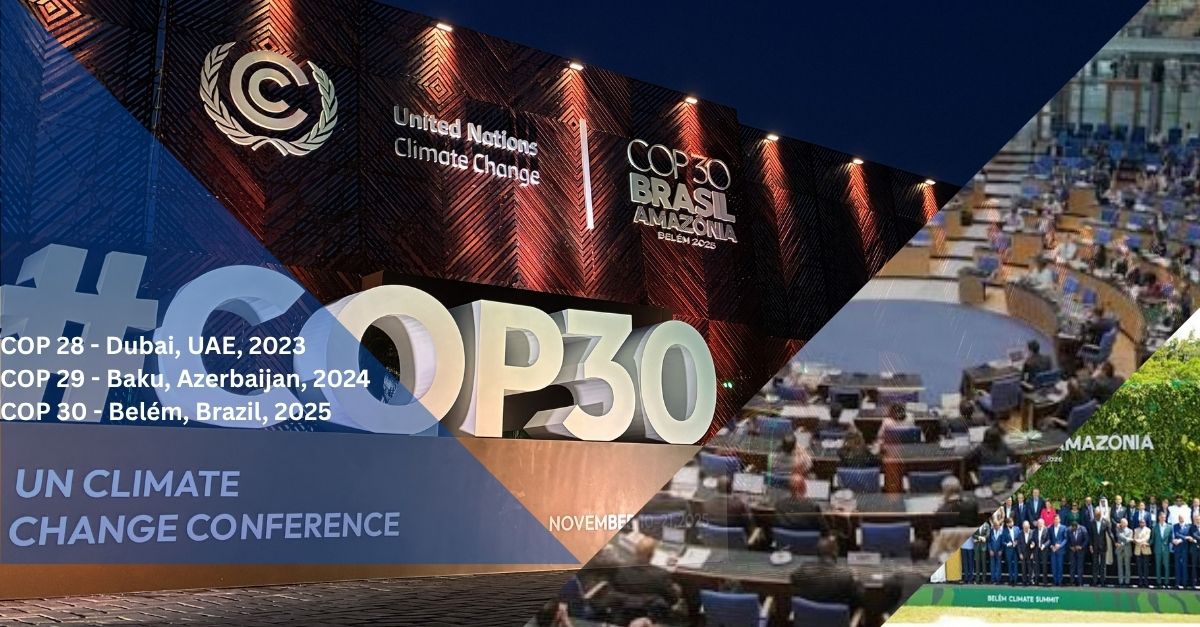
Held in Dubai in 2023, COP28 marked a historic moment in climate negotiations. For the first time in the history of the UN climate process, countries collectively acknowledged the need to transition away from fossil fuels in order to achieve global climate goals.
The conference also saw a commitment to triple renewable energy capacity and double energy efficiency improvements by 2030. These commitments reinforced the growing global consensus that decarbonization cannot be achieved without fundamentally transforming energy systems.
The conference was widely viewed as a breakthrough because it addressed the root cause of climate change more directly than previous negotiations. However, it was not without criticism. Many stakeholders argued that the language surrounding fossil fuels remained too flexible and lacked a clear timeline for phase-out, leaving significant room for interpretation and delayed implementation.
Nevertheless, COP28 sent a strong signal to governments, businesses, and investors that renewable energy, energy efficiency and low-carbon technologies would become central pillars of future economic development.
COP29: The Climate Finance COP
While COP28 focused on what needs to be done, COP29 in Baku shifted attention toward an equally important question: who will pay for it?
Climate action requires substantial investment. Whether it involves renewable energy projects, resilient infrastructure, climate adaptation programs or industrial decarbonization, financing remains one of the largest barriers to implementation.
The most notable outcome of COP29 was the agreement to mobilize USD 300 billion annually by 2035 to support developing countries in addressing climate challenges. This represented a significant increase from previous climate finance commitments and demonstrated growing recognition of the financial needs associated with climate action.
However, the agreement also exposed long-standing tensions between developed and developing nations. Several countries and climate experts argued that the actual financing requirement is closer to USD 1.3 trillion annually. As a result, many stakeholders viewed the new target as an important step forward but insufficient to meet the scale of the challenge.
The discussions highlighted a recurring theme in global climate governance: while there is broad agreement on the need for action, consensus becomes more difficult when discussions turn to responsibility and financing.
COP30: The Implementation COP
By the time countries gathered in Belém, Brazil, for COP30, the conversation had evolved once again.
The central message of COP30 was implementation.
After years of targets, pledges and financing discussions, the focus shifted toward demonstrating measurable progress. Climate adaptation, forest conservation, biodiversity protection, climate-resilient agriculture and accountability emerged as key priorities.
Hosting the conference in the Amazon region also brought greater attention to the role of forests and nature-based solutions in addressing climate change. Discussions emphasized that protecting biodiversity and ecosystems is not separate from climate action but an essential component of it.
Another notable development was the increased focus on adaptation. Historically, global climate discussions have concentrated heavily on reducing emissions. COP30 highlighted the reality that many climate impacts are already being experienced today, making adaptation and resilience equally important.
For countries such as India, where agriculture, water security and climate resilience are closely interconnected, this shift carries significant implications.
What Do These Three COPs Tell Us?
Viewed together, COP28, COP29, and COP30 represent three distinct stages of climate action.
- COP28 focused on the direction of the transition.
- COP29 focused on financing the transition.
- COP30 focused on implementing the transition.
This progression reflects the increasing maturity of the global climate agenda. Climate change is no longer being treated solely as an environmental concern. It is now recognized as an issue that affects economic development, trade, finance, supply chains, food systems and business competitiveness.
The growing emphasis on implementation is also influencing corporate sustainability practices. Businesses are increasingly expected to move beyond sustainability commitments and demonstrate measurable outcomes through ESG disclosures, climate risk reporting, carbon accounting and supply chain transparency.
Progress Worth Recognizing
There are several positive developments emerging from these conferences.
Renewable energy deployment continues to accelerate globally. Climate finance mechanisms are becoming more structured. Adaptation is receiving greater attention. Biodiversity and nature-based solutions are increasingly being integrated into climate discussions. Carbon markets are evolving and sustainability reporting frameworks are becoming more robust.
These developments indicate that climate action is becoming more embedded within economic and business decision-making than ever before.
The Challenges Remain
Despite the progress, significant concerns remain.
Global greenhouse gas emissions continue to rise in many regions. Climate finance commitments remain below estimated requirements. Adaptation funding remains insufficient for many vulnerable countries. Implementation often progresses more slowly than scientific recommendations suggest.
There is still a substantial gap between climate ambition and climate execution.
The challenge facing governments, businesses, and financial institutions is no longer identifying what needs to be done. The challenge is ensuring that commitments are translated into meaningful and measurable outcomes.
The Sustainability Perspective
From a sustainability perspective, the most important takeaway from COP28, COP29, and COP30 is that climate action is increasingly becoming a core business issue.
Regulations, investor expectations, supply chain requirements, sustainable finance mechanisms, carbon markets and ESG reporting obligations are all being shaped by the outcomes of these global discussions.
Organizations that proactively integrate sustainability into their business strategies will likely be better positioned to navigate future risks and opportunities. Those that delay adaptation may face increasing regulatory, financial, and market pressures.
Conclusion
The journey from COP28 to COP30 reflects an evolution in global climate governance, from ambition to finance to implementation.
While challenges remain and criticism is justified in several areas, these conferences collectively demonstrate that climate action is becoming more measurable, accountable and integrated into mainstream economic systems.
The key question is no longer whether the transition to a low-carbon economy is underway.
The real question is whether the pace of implementation is sufficient to meet the scale and urgency of the climate challenge ahead.