
Monsoon Climate Risk for Indian Businesses: From Disclosure to Operating Decisions
India’s southwest monsoon is often discussed through agriculture, reservoir levels and economic growth. For businesses, it should also be understood as a direct test of climate-risk management.
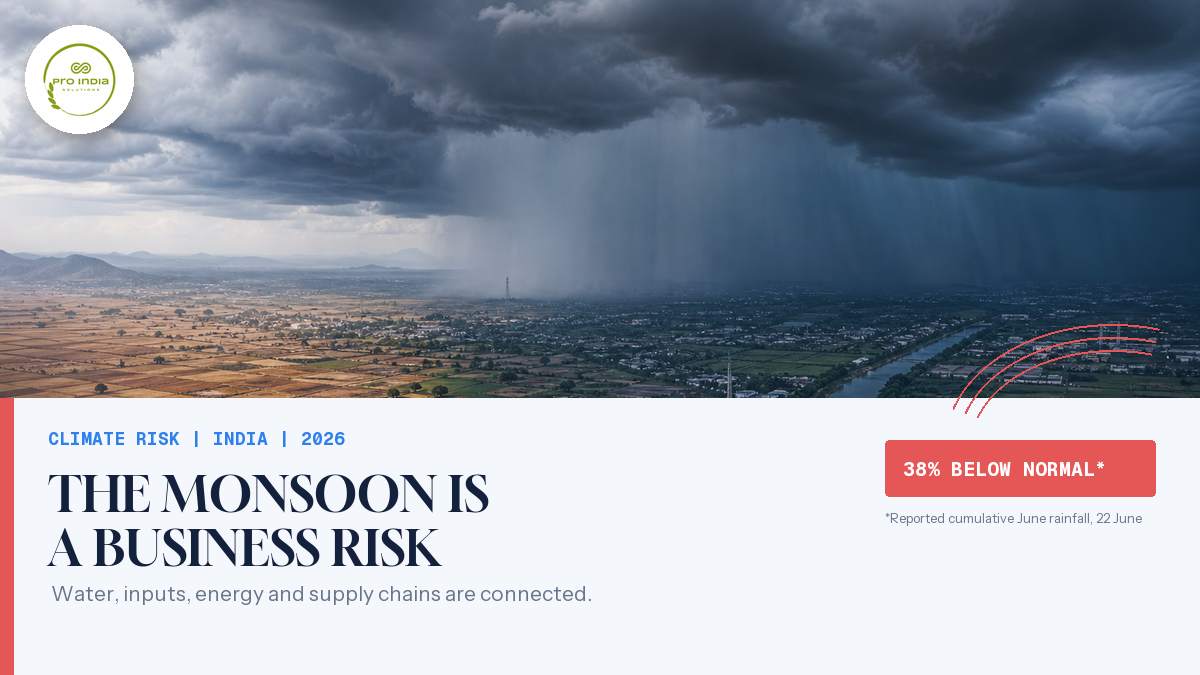
The India Meteorological Department’s long-range forecast placed 2026 seasonal rainfall at 92% of the long-period average, which falls in the below-normal category. By 22 June, cumulative rainfall for the month was reported to be 38% below normal. Regional outcomes were highly uneven: Uttarakhand reported a 32% deficit, while Goa’s shortfall exceeded 72%.
These figures will change as the season develops. That uncertainty is precisely the point.
A national rainfall number does not tell a company whether a specific factory, supplier cluster, farming region, transport route or urban market will have enough water or face disruptive rainfall. Corporate resilience depends on understanding local exposure and deciding what action should follow when conditions move beyond defined thresholds.
Why the 2026 Monsoon Deserves Boardroom Attention
The monsoon influences a large part of India’s economy, even when the connection is not immediately visible.
Agriculture-linked businesses depend on rainfall for crop volumes, quality and procurement prices. Food and beverage companies rely on farm output and local water. Textile, chemical, pharmaceutical, power, mining, construction and manufacturing facilities may operate in water-stressed districts. Consumer demand can change when rural incomes and food inflation move. Logistics networks face both dry-season constraints and extreme-rain disruption.
El Niño adds another layer of concern. The World Meteorological Organization has called for preparation as the event returns, while cautioning that its final strength and local impacts remain uncertain. El Niño often changes rainfall and temperature patterns across regions, but it does not produce the same outcome everywhere.
This makes climate risk a management problem rather than a forecasting contest.
Companies do not need perfect certainty about the season. They need clear exposure data, decision triggers, contingency options and accountability.
The Business Transmission Channels
Rainfall variability can travel through an organisation in several ways.
Water Availability
Industrial water exposure depends on the source, catchment, competing users, infrastructure and regulatory conditions around each site. A company may report total annual water withdrawal while missing the operational significance of local reservoir levels or groundwater restrictions.
Site teams should know:
- the reliability of each water source;
- which processes are most water-dependent;
- minimum operating requirements;
- alternative supply options;
- treatment and reuse capacity;
- community and ecological dependencies.
Water risk is not captured by a single efficiency ratio. A relatively efficient facility can still be vulnerable if it operates in a stressed basin with limited alternatives.
Agricultural Inputs and Commodity Prices
Food, beverages, textiles, bio-based materials, paper and several consumer industries depend on agricultural supply chains. Weak or poorly distributed rainfall can affect planting, yields, quality and market arrivals.
The commercial impact may appear through higher input costs, greater price volatility, supplier distress or changes in product availability.
Procurement teams should identify critical crops and sourcing regions before disruption becomes visible in spot prices. Diversification, supplier engagement, agronomic support and inventory policy should be reviewed against the actual exposure.
Energy Demand and Reliability
Low rainfall and extended heat can raise electricity demand through cooling and irrigation loads. Hydropower output may also be affected by reservoir conditions. At the same time, extreme rainfall can damage local infrastructure and interrupt distribution.
Energy-intensive facilities should consider climate conditions in demand forecasts, backup planning and contract strategy. Water and energy risks often reinforce each other: power is needed to pump and treat water, while water is required in many forms of power generation and industrial production.
Labour Productivity and Worker Safety
Delayed rainfall can extend periods of extreme heat. Heat stress affects outdoor workers, warehouses, construction sites, transport operations and facilities without adequate cooling.
Productivity, safety and working-hour decisions should be linked to heat and humidity thresholds. Protective measures need to be practical for contractors and temporary workers, not only permanent employees.
Logistics and Supplier Continuity
A weak monsoon does not remove the risk of intense local rainfall. A season can record an overall deficit while individual locations experience flooding, landslides or transport interruption.
Businesses therefore need to plan for both scarcity and excess. Supplier mapping should include water dependence, climate exposure, transport routes and the availability of alternative sources.
Where ESG Reporting Often Falls Short
Many companies now disclose water withdrawal, water intensity, climate targets and selected risks. These disclosures are useful, but they do not automatically create resilience.
The gap usually appears between the metric and the decision.
A company may know its annual water use but not the reservoir level that should trigger a production review. It may identify climate risk as “high” without assigning an executive owner. It may collect supplier ESG questionnaires without knowing which vendors are most exposed to rainfall or heat.
Effective climate-risk management should answer:
- What are the most vulnerable sites, suppliers and commodities?
- Which indicators are monitored, and how often?
- What threshold triggers action?
- Who decides whether procurement, production or logistics plans change?
- What alternatives are available?
- How will affected workers, suppliers and communities be considered?
The value lies in the operating response, not the risk label.
A Practical Monsoon-Risk Framework
Indian businesses can strengthen preparedness without building an elaborate climate model.
1. Map Exposure at the Right Level
Start with sites, major suppliers, sourcing districts and transport corridors. National or state-level averages are often too broad for operational decisions.
Record water sources, rainfall dependence, storage, critical inputs, workforce exposure and infrastructure constraints.
2. Identify Leading Indicators
Choose indicators that can influence decisions. These may include rainfall deviation, reservoir levels, groundwater restrictions, crop sowing progress, commodity arrivals, heat alerts, electricity demand or supplier delivery performance.
Avoid collecting data that nobody is responsible for interpreting.
3. Set Decision Thresholds
Define what happens when an indicator crosses a threshold. Actions may include increasing monitoring, changing inventory levels, activating alternative suppliers, adjusting production, restricting non-essential water use or escalating to management.
Thresholds should be reviewed with operations, procurement, finance, safety and sustainability teams.
4. Test Alternatives Before They Are Needed
An alternative water tanker, supplier or transport route is not automatically reliable during a regional disruption. Capacity, permits, quality, cost and competing demand should be checked in advance.
Scenario exercises can reveal whether a contingency plan exists only on paper.
5. Engage Critical Suppliers
Large companies often depend on MSMEs with limited working capital and climate-risk resources. A monsoon shock can become a customer disruption when a critical supplier lacks water, power or inventory.
Supplier support may include better forecasts, revised delivery planning, technical guidance, financing coordination or shared risk data. The objective is continuity, not another generic questionnaire.
6. Connect the Plan to Governance
Climate and water risks should have named owners, defined reporting frequency and senior-management visibility. Material issues should inform capital expenditure, sourcing, insurance and business-continuity planning.
This is also important for ESG credibility. Public commitments are more persuasive when the organisation can demonstrate how climate information changes decisions.
Sector-Specific Considerations
Food, Beverage and Agriculture-Linked Companies
Focus on crop regions, water availability, farmer resilience, commodity quality and supplier concentration. Consider how price and volume shocks may affect consumers as well as margins.
Manufacturing
Review process-water dependence, cooling requirements, effluent-treatment capacity, worker heat exposure and critical supplier locations. Assess whether water-reuse investments reduce local operating risk.
Financial Institutions
Banks and investors should examine how rainfall, heat and commodity shocks affect borrower cash flows, collateral, insurance and repayment capacity. Portfolio exposure can be concentrated by region or sector even when individual loans appear diversified.
Logistics and Infrastructure
Plan for road, rail, port and warehouse disruption from both extreme rain and extended heat. Review drainage, backup power, route alternatives and worker safety.
Real Estate and Urban Services
Consider water supply, cooling loads, stormwater management, tenant continuity and local infrastructure. Buildings need to perform under both scarcity and intense rainfall.
Regulatory and Disclosure Implications
India’s Business Responsibility and Sustainability Reporting framework asks large listed companies to provide environmental and risk information. Climate and water issues also influence investor assessments, customer requirements and financing decisions.
Companies should avoid presenting monsoon variability as an isolated natural event. Where exposure is material, it belongs within risk governance, business continuity, supplier management and environmental planning.
Claims should remain evidence-based. A company should distinguish between observed rainfall, forecasts, scenarios and management assumptions. Climate disclosure becomes less credible when precise business outcomes are claimed from uncertain weather data.
The Strategic Opportunity
Preparedness is not only defensive.
Better water measurement can identify process inefficiency. Supplier mapping can improve procurement visibility. Climate-informed capital planning can prevent stranded or vulnerable investments. Products and services supporting efficient irrigation, water treatment, cooling, storage, forecasting and resilient infrastructure may see greater demand.
Companies that respond early can protect operations and build stronger relationships with suppliers, customers, workers and communities.
The objective is not to predict every monsoon outcome. It is to make the business less dependent on one favourable outcome.
What Management Should Ask Now
Before the season progresses further, boards and leadership teams should ask:
- Which sites and suppliers face the highest rainfall and water exposure?
- What indicators are being monitored weekly?
- Which thresholds trigger management action?
- Are alternative suppliers, water sources and transport routes genuinely available?
- How are worker heat and safety risks being managed?
- Does ESG reporting reflect the operating plan?
Clear answers are more valuable than a long climate-risk register.
Conclusion
India’s 2026 monsoon outlook is an immediate test of corporate climate resilience. The season may improve, remain deficient or produce sharply different regional outcomes. Businesses cannot control that uncertainty.
They can control whether climate information reaches procurement, operations, finance, safety and senior management in time to influence decisions.
PRO India helps businesses connect ESG and sustainability risks with practical systems for water, supply chains, compliance, governance and implementation.
To review your organisation’s climate and water-risk readiness, visit ProIndia.net.
Frequently Asked Questions
What is India’s 2026 monsoon forecast?
IMD’s long-range forecast placed southwest monsoon rainfall at 92% of the long-period average, categorised as below normal. Actual rainfall will vary by time and location as the season develops.
Why does monsoon risk matter to non-agricultural companies?
Rainfall affects industrial water, electricity demand, hydropower, logistics, food and commodity prices, workers, suppliers and consumer demand. Exposure can therefore extend across many sectors.
What is corporate water risk?
Corporate water risk is the possibility that water quantity, quality, regulation, infrastructure or competing demand affects operations, supply chains, costs, reputation or communities.
How should companies monitor monsoon risk?
Businesses should track site- and supplier-relevant indicators such as rainfall deviation, reservoirs, restrictions, crop progress, heat alerts, commodity availability and delivery performance.
What is the difference between disclosure and resilience?
Disclosure explains exposure and performance. Resilience requires decision thresholds, responsible owners, contingency options, investment and evidence that climate information changes operations.
How can MSME suppliers be included?
Large companies can identify critical MSMEs, simplify data requests, share forecasts, discuss contingency plans and provide practical support where supplier disruption would affect continuity.