July 3, 2026
MNRE now permits procurement of scheduled power from prototype wind turbines. Understand the business impact.



MNRE now permits procurement of scheduled power from prototype wind turbines. Understand the business impact.
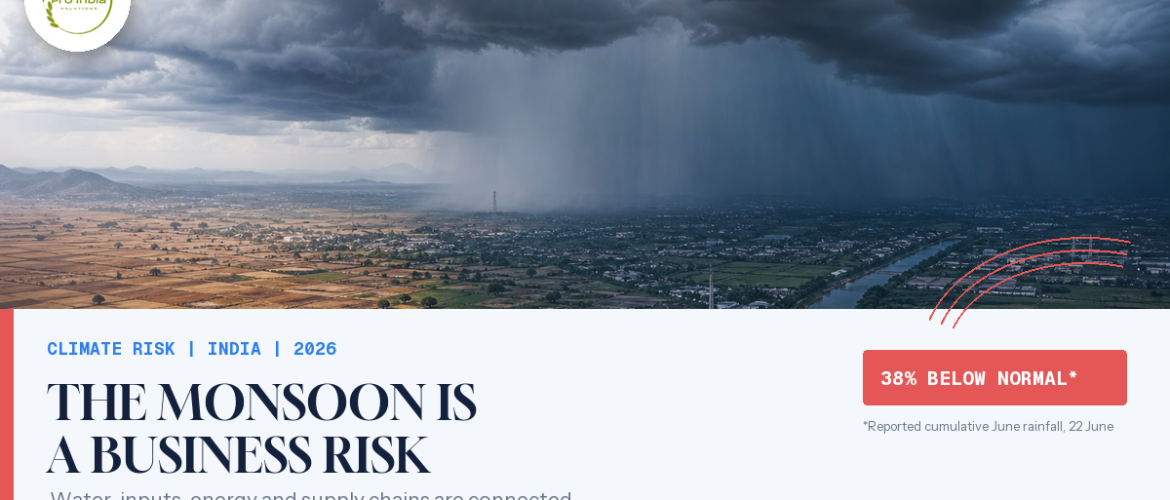
India’s below-normal 2026 monsoon outlook is a practical test of corporate climate resilience. Businesses need clear plans for water, inputs, energy, suppliers and operational continuity.
COP28, COP29 & COP30: A Three-Year Journey from Ambition to Action Over the past three years, the global climate conversation has undergone a significant transformation. While climate conferences have often been criticized for producing ambitious declarations without corresponding action, the progression from COP28 to COP30 reveals an important shift in priorities. The focus is gradually moving from setting climate ambitions, to identifying financial mechanisms, and finally to implementing measurable actions on the ground. For sustainability professionals, businesses, investors, and policymakers, understanding this
India’s sustainability reporting ecosystem is entering a new phase of maturity, and BRSR Core may become one of the most influential developments shaping the future of corporate ESG accountability in the country. What initially appeared to many as an extension of sustainability disclosure requirements is now gradually evolving into something much larger a structural transformation in how businesses measure, manage, and communicate environmental, social, and governance performance across their entire value chain. When the Securities
The Carbon Border Adjustment Mechanism (CBAM) is set to reshape global trade dynamics, and Indian exporters need to pay close attention. In simple terms, CBAM is the European Union’s way of putting a carbon cost on imported goods such as steel, cement, aluminum, and fertilizers, based on the emissions generated during their production. This means that if Indian products are more carbon-intensive compared to European standards, they could become more expensive and less competitive

Strengthening Quality Performance Through Data and Defect Reduction Six Sigma offers MSMEs a structured way to reduce defects, improve consistency, and control operational waste. While world-class performance targets 3.4 defects per million opportunities, many MSMEs operate at a 2 to 3 sigma level with very high defect rates. Even improving to 4 sigma can reduce defects by nearly 90 percent and save 10 to 15 percent of revenue. Using the DMAIC approach helps MSMEs define specific problems, measure performance, and analyze

India’s Climate Commitments Create New Expectations for MSMEs India has committed to achieving net-zero emissions by 2070 and reducing emissions intensity by 45% by 2030 under the Paris Agreement. These commitments are not abstract policy goals; they translate into concrete expectations for every segment of industry, including the MSME sector. With MSMEs contributing nearly 30% of India’s GDP and employing millions across manufacturing, services and trade, their participation in the sustainability journey is no longer optional. Large corporations are cascading climate

Introducing the 3rd FICCI Sustainable Industrial Practice Awards: What’s new this year? Expanding Scope to Reflect Emerging Priorities The FICCI Sustainable Industrial Practice Awards have evolved with each edition, and the third edition introduces notable enhancements that reflect the maturation of sustainability thinking in Indian industry. One significant addition is the inclusion of new assessment categories covering circular economy practices, water stewardship and biodiversity impact alongside the traditional focus areas of energy efficiency, emissions reduction and waste management. This broader lens acknowledges

Optimizing Core Cost Drivers to Strengthen Cost Efficiency For most MSMEs, materials, energy, labor, and maintenance make up the bulk of operating costs, making these areas essential targets for improvement. Materials alone account for 50 to 70 percent of spending, and practices such as just-in-time inventory can reduce carrying costs by 15 to 25 percent. Partnering with a small group of reliable suppliers ensures better pricing and consistency, while daily waste tracking often uncovers 10 to 15 percent savings. Energy costs,