
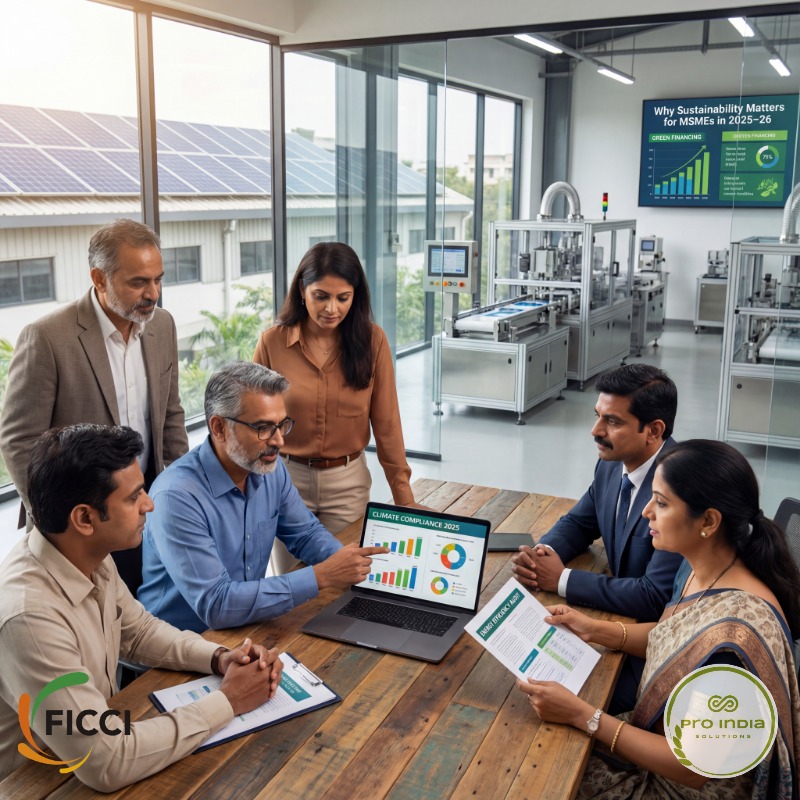
India’s Climate Commitments Create New Expectations for MSMEs
India has committed to achieving net-zero emissions by 2070 and reducing emissions intensity by 45% by 2030 under the Paris Agreement. These commitments are not abstract policy goals; they translate into concrete expectations for every segment of industry, including the MSME sector. With MSMEs contributing nearly 30% of India’s GDP and employing millions across manufacturing, services and trade, their participation in the sustainability journey is no longer optional. Large corporations are cascading climate targets down their supply chains, and MSMEs that serve as vendors, suppliers and partners are increasingly being asked to demonstrate energy efficiency, emissions tracking and resource management. For many small enterprises, this marks the first time sustainability has moved from a peripheral concern to a core business requirement.
National Policies and Schemes Are Backing Green MSMEs
Recognizing the pivotal role of MSMEs, the Government of India has rolled out several initiatives to support green transitions. The ZED certification scheme offers subsidies and technical assistance to help small units adopt cleaner technologies and improve resource productivity. The 2025 Union Budget discussion highlighted plans for a dedicated Green MSME policy framework, aimed at simplifying access to green finance, technology upgrades and capacity building. Institutions like SIDBI have expanded green credit lines specifically for energy efficiency, renewable energy installations and circular economy projects within the MSME ecosystem. These policy signals make it clear that sustainability is being woven into the fabric of MSME development, and enterprises that align early will benefit from easier credit, lower operating costs and enhanced market credibility.
Global Buyers and Domestic Markets Are Raising the Bar
Beyond policy, market forces are accelerating the sustainability imperative. Export-oriented MSMEs are encountering stricter environmental and social compliance requirements from buyers in the EU, North America and other regions, where regulations like the Carbon Border Adjustment Mechanism are beginning to take effect. Even within India, large buyers in sectors like automotive, pharmaceuticals and electronics are formalizing ESG criteria in their vendor selection and audit processes. MSMEs that proactively adopt sustainable practices, document their environmental performance and seek third-party verification will find it easier to retain existing customers, win new contracts and differentiate themselves in competitive markets. Aligning with national and global climate commitments is not merely about compliance; it is about securing a seat at the table in a rapidly evolving industrial landscape.