Introduction
As sustainability becomes central to business strategy and consumer behavior, two terms often dominate the conversation: recycling and upcycling. Both are waste management techniques, but they differ significantly in process, output, and environmental impact.
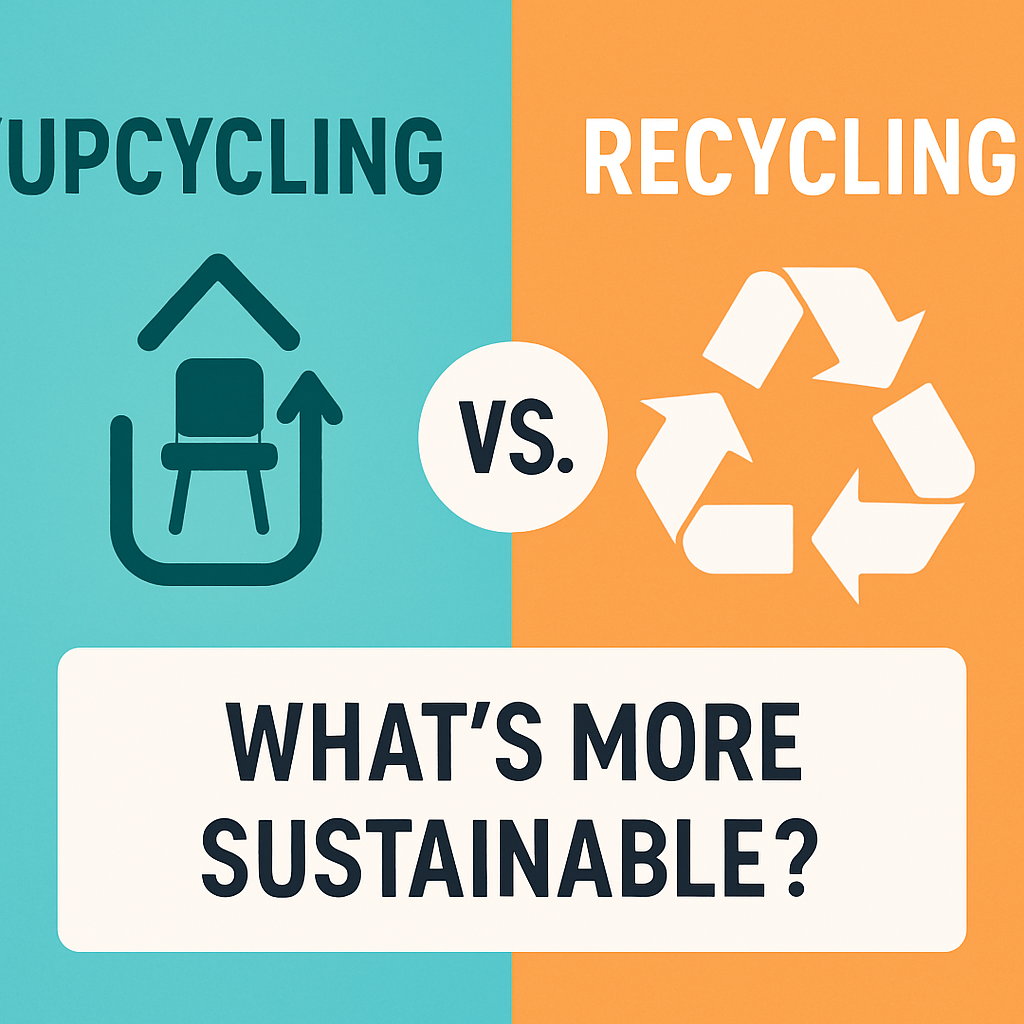
So, which is more sustainable—upcycling or recycling? In this blog, we unpack the differences, explore their respective benefits and limitations, and help you understand which approach aligns better with a circular economy.
What is Recycling?
Recycling is the process of breaking down waste materials and reprocessing them into new, often lower-quality products. For example:
-
Plastic bottles → turned into polyester fabric
-
Aluminium cans → melted into new cans
-
Paper → reprocessed into cardboard
While recycling helps divert waste from landfills, it often involves energy-intensive processes, chemical treatments, and downcycling (reduction in material quality).
What is Upcycling?
Upcycling involves repurposing or creatively reusing materials in a way that retains or enhances their value. Unlike recycling, it does not involve breaking down the material chemically or mechanically.
Examples include:
-
Turning old jeans into handbags
-
Converting pallets into furniture
-
Creating home décor from discarded glass bottles
Upcycling is more of an art-meets-sustainability approach—often low-energy, high-impact, and increasingly popular in fashion, furniture, and DIY communities.
Key Differences: Upcycling vs. Recycling
| Feature | Recycling | Upcycling |
|---|---|---|
| Process | Involves breaking down and reprocessing | Repurposes without breaking down |
| Energy Use | High | Low to moderate |
| End Product | Often lower quality (downcycled) | Maintains or increases value |
| Scale | Industrial and large-scale | Mostly small-scale or artisanal |
| Cost | Higher infrastructure costs | Lower cost, DIY-friendly |
| Carbon Footprint | Higher due to transportation and energy | Lower due to minimal processing |
Which is More Sustainable?
✅ Upcycling Wins on Energy Efficiency
Upcycling typically uses fewer resources, requires no factories, and avoids emissions from high-temperature processing.
✅ Recycling Wins on Volume Handling
Recycling is better suited for managing large quantities of waste, especially in urban areas and industrial settings.
✅ Upcycling Encourages Creativity & Local Economy
By supporting small artisans, craft industries, and local markets, upcycling promotes economic inclusivity and low-carbon lifestyles.
✅ Recycling Helps Close the Loop
Modern closed-loop recycling systems in metals, glass, and certain plastics ensure materials are reused indefinitely.
🔄 Conclusion:
Upcycling is more sustainable in terms of energy and environmental impact, especially when dealing with small or niche waste streams. However, both approaches are essential, and their combined use can drastically reduce landfill burden and conserve resources.
Challenges in Both Approaches
Recycling
-
Contamination of materials
-
Expensive sorting infrastructure
-
Downcycling reduces lifespan
Upcycling
-
Limited scalability
-
Dependence on consumer creativity
-
Market acceptance and design limitations
How Individuals Can Contribute
-
Choose upcycled products from ethical brands
-
Recycle properly—clean, dry, and sorted materials
-
Support community DIY and maker spaces
-
Promote zero-waste lifestyle choices
How Businesses Can Help
-
Encourage design for recyclability or upcyclability
-
Launch upcycled product lines
-
Collaborate with artisans and NGOs
-
Integrate both models in CSR and ESG strategies
Conclusion
The choice between upcycling and recycling isn’t either-or—it’s about context and intent. While recycling supports systemic waste management, upcycling brings creativity, local impact, and low emissions to the table. Together, they serve as powerful tools to reduce environmental degradation and move closer to a sustainable, circular future.